

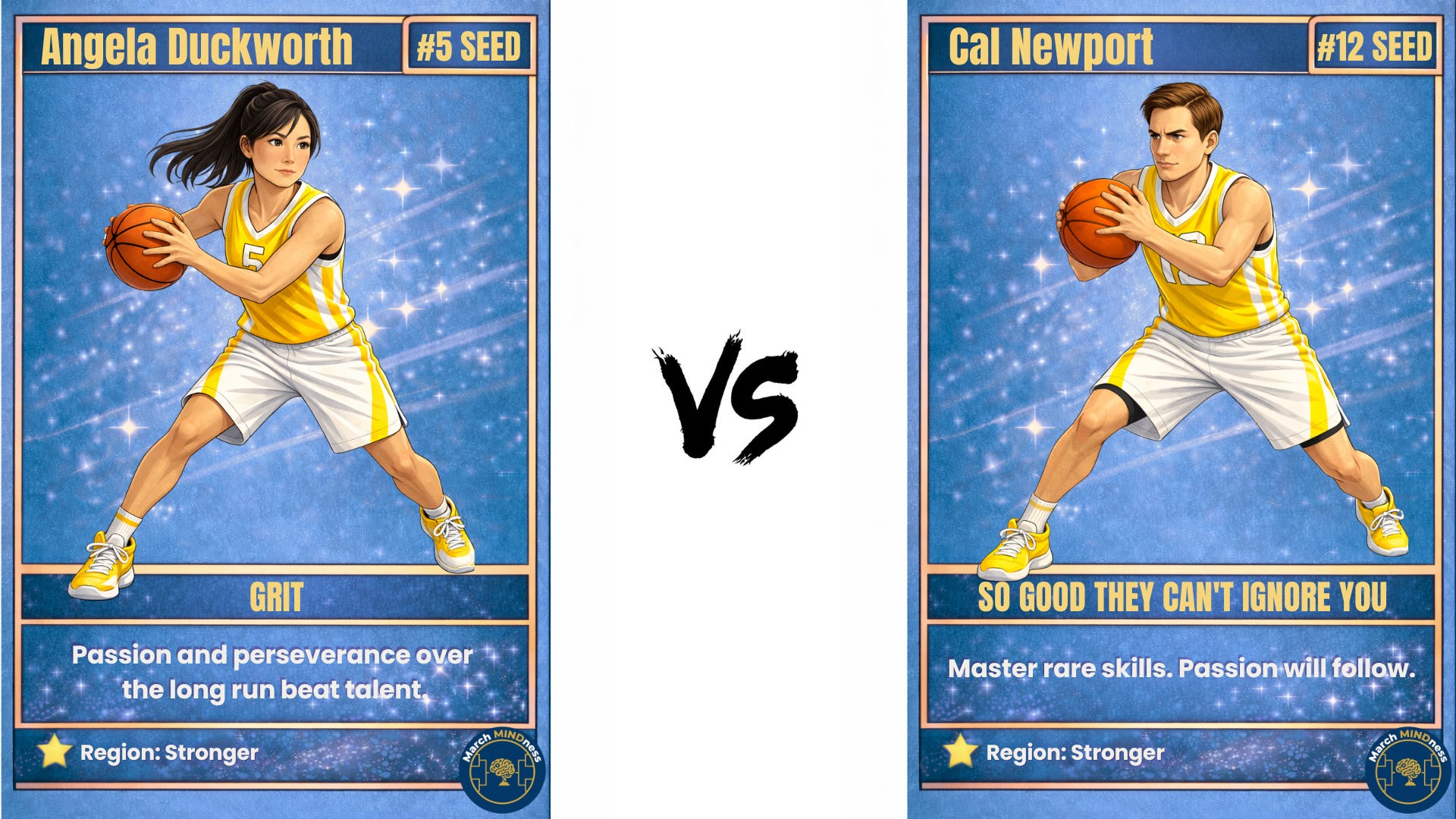
This is #5 vs #12 seed in the Stronger region of March MINDness, a self-help bracket tournament. If you don’t know these books, I’ll read them for you below.
My son Brian is 13 years old. He’s been training and playing tennis for four years. Here are two things:
He hasn’t been good. Just like me at his age, athletic stuff didn’t come naturally. When he first started, his frustration would boil over during matches and he would fight himself more than the opponent. His first coach was hesitant to take him on. For us, seeing him not melt down was a moral victory, because the real ones weren’t coming.
He doesn’t want to quit. Most kids who tried something and got beaten over and over would have quit long ago. But for Brian, he says he loves tennis and just keeps going.
For me and Tracy, we have vowed to support him as long as he wants to play tennis. But is it a wise idea? Should we gently encourage him to pivot to something that he can win more? Should the time and money go toward something with higher long-term ROI, like AI training, public speaking, robotics, or even a Roth IRA?
And you? Maybe you have a Brian. Maybe you are a Brian. Should you “follow your passion” or “find your strength”? This battle has been raging in the personal development world for 20 years.
At the center of this debate are two authors: Angela Duckworth and Cal Newport. Let’s hear what they have to say about Brian, and you.
Angela Duckworth
Born 1970 to Chinese immigrants, she looks like my cousin after taking the “limitless pill.” Her father was a chemist at DuPont who told her she was “no genius”, a line that became her career origin story. She went to Harvard, Oxford, Jedi Academy (just kidding), then got a PhD at Penn where she became a professor and won the 2013 MacArthur “Genius Grant.” (I wonder how that conversation with her dad went. But I know (and I am a) Chinese parent. It probably went “Where is Nobel?”)
Before the academic track, she did something unusual, leaving a consulting job at McKinsey to teach math in New York City public schools. That’s where she noticed something: the kids who succeeded weren’t necessarily the smartest. They were the ones who kept going. That observation became her life’s work.
Grit (2016)
Stayed on the NYT bestseller list for 21 weeks. The thesis: talent is overrated. The real predictor of success, across West Point cadets, spelling bee champions, salespeople, teachers in tough schools, is grit, which she defines as passion plus perseverance for long-term goals. Not short-term intensity. Long-term consistency.
Core Ideas:
Effort counts twice. Her key formula: talent × effort = skill, then skill × effort = achievement. Without effort, talent is just unrealized potential.
Grit is passion plus perseverance. Not passion as in falling in love with something for a weekend. Passion as in staying committed to the same top-level goal for years and years. Consistency of direction, not intensity of feeling.
Interest → Practice → Purpose → Hope. That’s the progression. First you discover genuine interest. Then you commit to deliberate practice (targeting weaknesses, not just doing reps). Then you connect your work to a larger purpose beyond yourself. Then hope sustains you through setbacks.
Grit can be grown. It’s not fixed at birth. Your grit score changes over time. Environment, parenting, coaching, culture, all of it can build or erode grit.
The hierarchy of goals matters. Gritty people have a clear top-level goal that organizes everything beneath it. They’re flexible on low-level tactics but stubborn on the ultimate direction.
Cal Newport
Newport was the grandson of a Baptist minister and theologian. He was a prodigy of a different kind - signing his first book deal with Random House before he turned 21 while still an undergrad at Dartmouth. He’s now a full professor of computer science at Georgetown.
This is the unusual part: he’s a legit academic computer scientist, but people know him for his influence on productivity and career advice. (David Epstein would be proud of him.) He famously has never had a social media account, which is either the most authentic or most annoying thing about him, depending on who you ask.
He has two great books. The famous one is Deep Work (2016), but I am choosing to highlight So Good They Can’t Ignore You.
So Good They Can’t Ignore You (2012)
“Follow your passion” is bad advice. Preexisting passions are rare, and the people who love their work didn’t find a job that matched a passion. They got really good at something valuable, which then generated passion. Build “career capital” (rare and valuable skills), then cash it in for autonomy and meaning. The title comes from Steve Martin’s advice to aspiring entertainers. Four rules: don’t follow your passion, be so good they can’t ignore you, turn down a promotion, think small and act big.
Core Ideas:
“Follow your passion” is dangerous. Passion doesn’t lead to great work. Great work leads to passion. Get good first, love comes later.
Career capital theory. Rare and valuable skills are the currency of a great career. Accumulate them, then trade them for autonomy and meaning.
Craftsman mindset beats passion mindset. Stop asking “what can the world offer me?” Start asking “what can I offer the world?”
Control requires capital. Want more freedom? Earn it first. Autonomy without valuable skills to back it up leads to broke.
Think small, act big. Don’t wait for a grand vision. Build skills, make small bets, and let your mission emerge from mastery, not before it.
Comparison
These two professors would both see Brian and shake their heads, but for the opposite reasons.
Duckworth would say “What a remarkable example of grit! Four years of training, with very little positive reinforcement from results. Yet he keeps going!”
Newport would say “Parents should encourage kids to not chase passion, but talent. If the kid finds something he’d excel at quickly, he can find real passion through victory.”
Duckworth would say “The grit Brian is developing through tennis will spill into other parts of his life. He will be successful at anything he does. Think about how much better of an executive he will be with this tennis grit!”
Newport would say “The kid could be building rare, valuable skills on top of natural talent. Grit would come along for the ride. Think about how great of an executive he can be if he’s practicing public speaking right now!”
If you have to choose one piece of advice for someone like Brian, or your own version of him, which one would you go for? Develop grit or skills? Follow your passion or talent? Tennis or no tennis?
Cast your vote below.
My Vote
So why aren’t we directing Brian to something that’s not tennis? The reason is simple: I read Duckworth’s book. And I want to instill every ounce of grit into Brian’s character through tennis.
And my 13-year-old is inspiring us every day with his own action.
When I contemplate giving up after frustration and failures, I don’t get inspiration from Michael Jordan, Tom Brady, or Rudy Ruettiger. I think about Brian.
When I think about my proudest moment as a dad, it’s not him hoisting trophies. It’s him saying “I want to keep going” after crying over a lost match.
When I see his future, I don’t just see a tennis champion, but a life champion.
Cal Newport might be right about the money ROI. But happiness and moments like this past weekend have the highest life ROI.
This past Saturday, Brian just had his breakout performance, splitting the first two sets with an opponent ranked much higher than him. In the third deciding set, a 10-point tiebreak, he was down 2-8. He didn’t give up and clawed back point after point. He won the set (and the match) 12-10. His coach, and of course us, were blown away.
That hug afterward is not something money can buy. That’s what being a dad is all about.
In my opinion, grit is a talent in itself. And for that, Brian is a child prodigy.
My vote goes to Angela Duckworth and my son Brian.
What an amazing story! Actually, I was not even expecting such a positive ending (sorry for not believing in Brian enough). But yes, my vote would have gone to Angela "Padawan" Duckworth anyway.
Thanks for the thought, Jia! Newport has great career advice, but his life advice would probably mirror Duckworth's in this instance. Rest and enjoyment are, in fact, important, and Newport really stresses this in his book, "Digital Minimalism." Thanks to the grit your son develops in tennis, he will go really, really far when he finds the easy thing he can get passionate about, and will be far more patient due to the lessons tennis taught him.
Further, I think it's also always worth investigating where, how and why our kids struggle. In tennis, that could look like double checking our fundamentals, ruling out unneeded tension, working on the mental side of it, or some other earlier life lesson that didn't land quite right the first time. In my life, I struggled to learn guitar, in no small part because I was pushing the strings way too hard. I also bottomed out my keys when I typed. It wasn't until I got my autism Dx that I realized the two were linked to poor proprioceptive skill. As I work on that, my guitar playing and typing started to improve naturally.
Unfortunately for me, this lack of care early on led a potentially career-ending injury -- carpal tunnel -- because this puzzle was not solved quickly enough to avoid taking significant and unknown self-damage. I'm glad that the kids of today are having these issues caught more early, more often.