

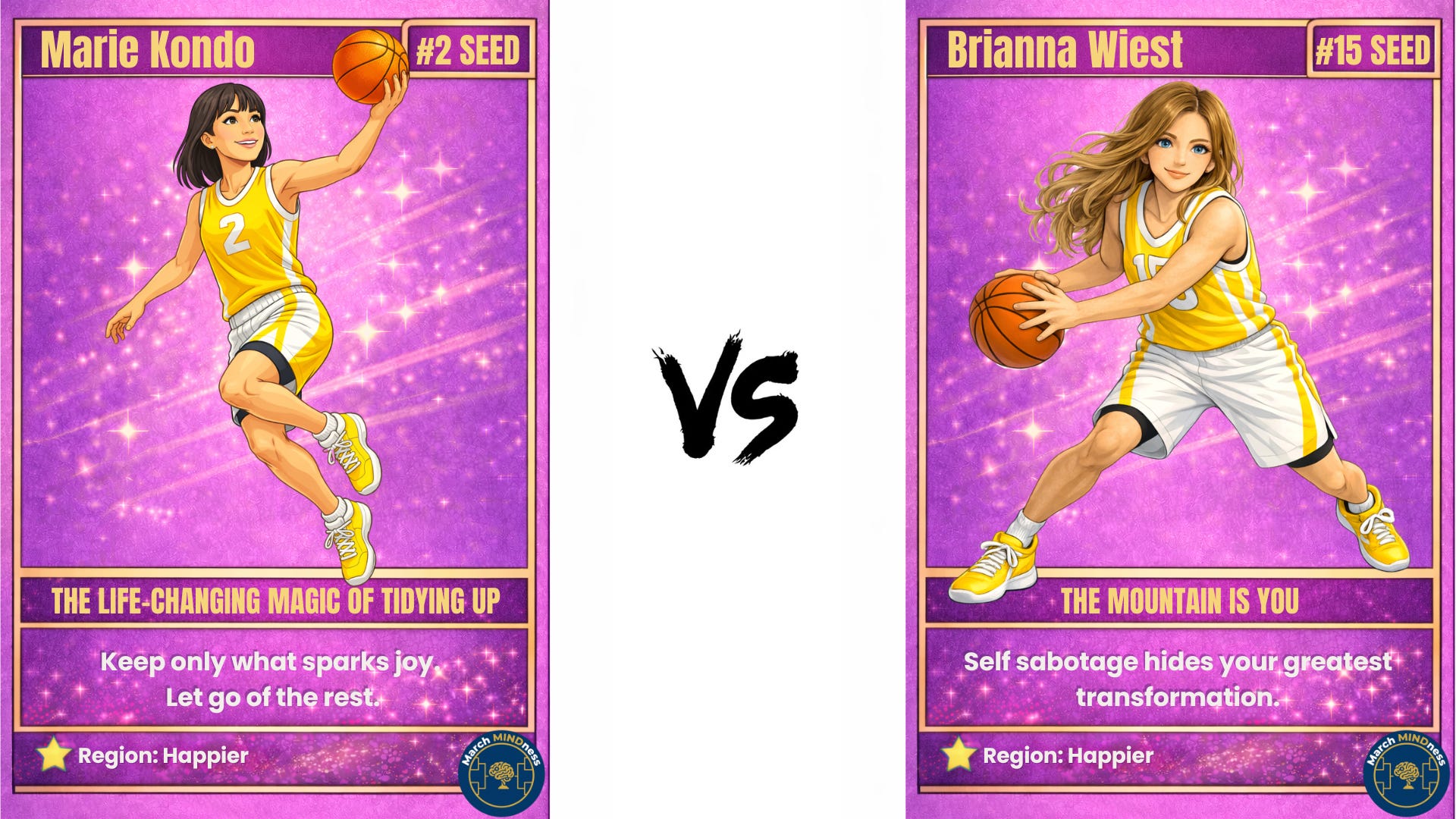
This is #2 vs #15 seed in the Happier region of March MINDness. If you don’t know these books, you can find their core ideas here.
This is me:
Getting up in the morning, seeing my side of the bed is a total mess. There’s stuff on my nightstand that was last used in the Obama administration, and I don’t remember for what. Walking into my study trying to write, and saw letters piling up from the last six months. Yeah I’ve dealt with the most important ones... kinda, maybe, probably not. Well maybe someday the IRS/DMV/local humane society will arrest me, and I’ll hire a lawyer then. But what does this say about me? Cluttered space is a cluttered mind. It’s time to search Roomba for Brain on Amazon.
Then I’m writing this article. But... “Who is this for? Me, my readers? The universe? What are the metrics of success? Funmaxxing? Going viral? Inviting God to talk to me? What if no one cares? What if everyone cares? I don’t care what anyone else thinks. But if I have to say that to myself, that means I care right?” All these thoughts just constantly bomb my brain like it’s inside an Iranian bunker.
Let’s see what these two bestselling authors of decluttering can help me.
Marie Kondo
A Japanese organizing consultant who turned the act of folding your underwear into a global spiritual movement. She was five years old when she looked at her mother’s house and thought — not clean enough. While other kids played during PE, she ran into the classroom to organize bookshelves. At 15, she was tidying so obsessively she passed out for two hours. When she woke up, she heard a voice telling her to “look at things more closely.”
She spent five years as a Shinto shrine maiden, started a consulting business at 19, and turned her tidying method into a book that sold 14 million copies, a Netflix show streamed in 190 countries, and a two-word phrase, “spark joy” that entered the English language.
The Life-Changing Magic of Tidying Up
Your house is a mess because you’ve been asking the wrong question. Instead of “what should I throw away,” ask “what do I want to keep?” Hold each item. If it sparks joy, it stays. If not, thank it and let it go. It sounds like a book about folding socks. It’s actually a book about deciding who you are now and letting go of who you used to be.
Core Ideas:
Spark joy is the only criterion. Not “is it useful” or “did I pay a lot.” Does holding it make your heart flutter? Your body knows before your brain does. This is Daniel Kahneman’s System 1 at work.
Category, not location. Don’t clean room by room. Pile ALL your clothes first, then books, then papers, then sentimental items last. Easy decisions first.
One massive purge. No “a little each day.” Half-measures are why you’ve cleaned your closet twelve times.
Every item has a home. Clutter isn’t a stuff problem. It’s a homeless stuff problem.
Thank it before you toss it. Say thank you to objects before throwing them away.
If you read her book, you’ll be amazed by how matter-of-fact she makes everything sound. No philosophizing, no trying to provide rationale. Just go ahead and throw away.
Brianna Wiest
A Thought Catalog blogger who accidentally wrote the manual of the therapy generation. She had anxiety, OCD, and depression as a teenager, and started writing because she needed to read something that made her feel less broken. One of her articles got shared 8 million times. (Don’t you just hate that?) In 2020 she self-published The Mountain Is You. Nothing happened. Then TikTok found it. One quote went viral, three million copies sold. She has no psychology degree, no therapy license, no clinical anything. Everything she’s ever written is a letter to her younger self. Turns out a lot of people needed that letter too.
The Mountain Is You
You keep getting in your own way and can’t figure out why. You set goals, make plans, then somehow blow them up. Wiest’s argument: that’s not laziness. It’s self-sabotage, and self-sabotage is a misfired protection system. Your brain decided at some point that staying stuck was safer than moving forward. The mountain between you and the life you want isn’t circumstances or bad luck. It’s you. Sounds harsh. It’s actually the most hopeful thing in the book. Because if you’re the problem, you’re also the solution.
Self-sabotage is self-protection. Your brain learned staying small was safest. It’s still running that program.
Conflicting needs create the mountain. You want success but subconsciously fear what it costs.
Uncomfortable doesn’t mean wrong. That’s unfamiliarity, not danger.
Microshifts over breakthroughs. Tiny conscious choices rebuild your life the same way tiny unconscious ones wrecked it.
Future self as compass. Ask “what would they do right now?” and do that.
Comparison
If both Marie Kondo and Brianna Wiest came to my house, and I asked them how they could help me, they would both say: “Declutter!” and high-five each other. But after that, all hell would break loose. Because they would agree on nothing.
Kondo would say “Your room is a mess and so are you. Dealing with all your letters will give you the best workspace and cleanest mind.”
Wiest would say “Your room isn’t the problem. Your thoughts are. You aren’t dealing with your letters because you think not knowing the content is safer than knowing.”
Kondo would say “Hug your items and see if they spark joy.”
Wiest would say “Examine your thoughts and see if they cause havoc.”
Kondo cleans from the outside in. Wiest cleans from the inside out.
And you?
What’s your situation? Vote here. And tell me who helped you more in the comments. Please vote yourself and don’t let my thoughts impact you.
For me.
One day Tracy read The Life-Changing Magic of Tidying Up. Two hours later, she put all our old clothes in a bag and donated it to Goodwill. I went into my closet and found my clothes had been cut by two-thirds — the polo from my teenage years, the company shirt my colleagues signed on my last day, the school shirt I wore on our first date, all gone. I let out a scream so loud my sons thought I lost a game of Minecraft. But now, I don’t miss any of those items. In fact, I wish Tracy would read that book every day.
But today, I am decluttering my thoughts the way Wiest is suggesting. So far, I’ve packed up and donated these thoughts to the Goodwill of consciousness:
“What if no one votes.”
“What if my fingers fall off.”
“What if everyone sees through me.”
“What if everyone unsubscribes.”
Instead, I’m picking up:
“Let’s make these authors’ thoughts help me as much as possible.”
“And let them help my readers even more than me.”
“Let’s have the most fun.”
My vote goes to Brianna Wiest for the upset.
It’s probably just because I’m always go for EASY. Cleaning stuff requires labor. Cleansing my thoughts requires the actions below, and an occasional Amber Ale. I go for the easy stuff.

Im starting to think, Jia, by plotting these results in an excel sheet you will know exactly how the brain of your average user works (40% prefer X, 60% prefer Y). That will allow you to write posts that more accurately adress the needs of your subscribers.
Im not sure if this was one of your intentions, but it definitely is an added benefit (for you because you get more reads, and for your subscribers because they feel more understood).
Thank you for this write-up! I really enjoyed it, and I voted for Brianna as well. With Marie, the change may not endure long enough to become a lasting discipline. In the short term, it offers a quick win and a fast turnaround, but Brianna’s inside-out approach feels more enduring in the long run. That doesn’t mean renewing one’s mind is a one-and-done task; rather, it can anchor me to be more proactive across all areas of life.