

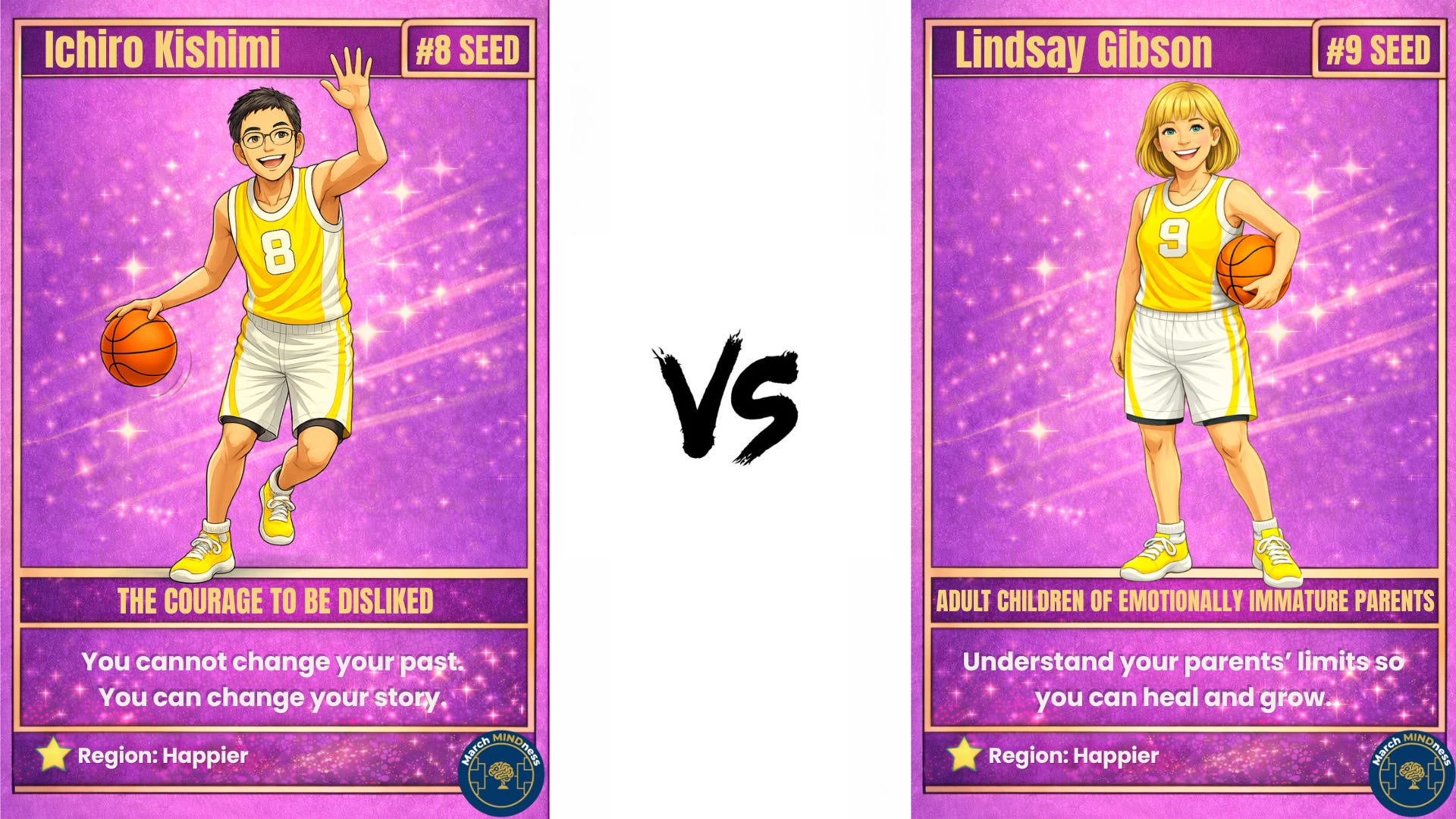
This is the first round of March MINDness, a bracket tournament for self-help authors and books. Happier Region: 8th seed vs 9th seed. If you haven’t read the books, no worries. I’m reading it for you.
Does this sound familiar? You’ve got a friend. He’s approachable enough on the surface, but if you’ve been around him for long, you know he’s like a lactose intolerant person stuck on the window seat on a 6-hour flight after downing a bottle of whole milk. His anger can explode anytime, out of nowhere, and ruin your (or everyone’s) whole day.
And when you dig a little, you find he’s got deep daddy/mommy issues. His emotionally immature parents caused him some major harm.
So you might stay friends by walking on eggshells around him, or you say “hell with this” and just move on.
But not you. Your inner angel whispers: no! He needs your help. You are the only one who can save him.
So what do you say? You have two choices:
“Buck up and grow a pair! Your past doesn’t define you.”
“Oh man, that sucks. Tell me more about your parents.”
No. That’s not the fight of your inner voices, but that of two renowned psychologists/philosophers/mind readers. Let’s set up the fight rings… or the couch, and see who comes out on top.
Ichiro Kishimi – The Courage to Be Disliked
Japanese philosopher and psychologist. He’s a quiet academic in Kyoto who runs a private counseling office and gives lectures on Adlerian psychology. Then he wrote a fictional dialogue (argument, rather) between an angry young man and an elderly philosopher, teaching people the ideas of Alfred Adler.
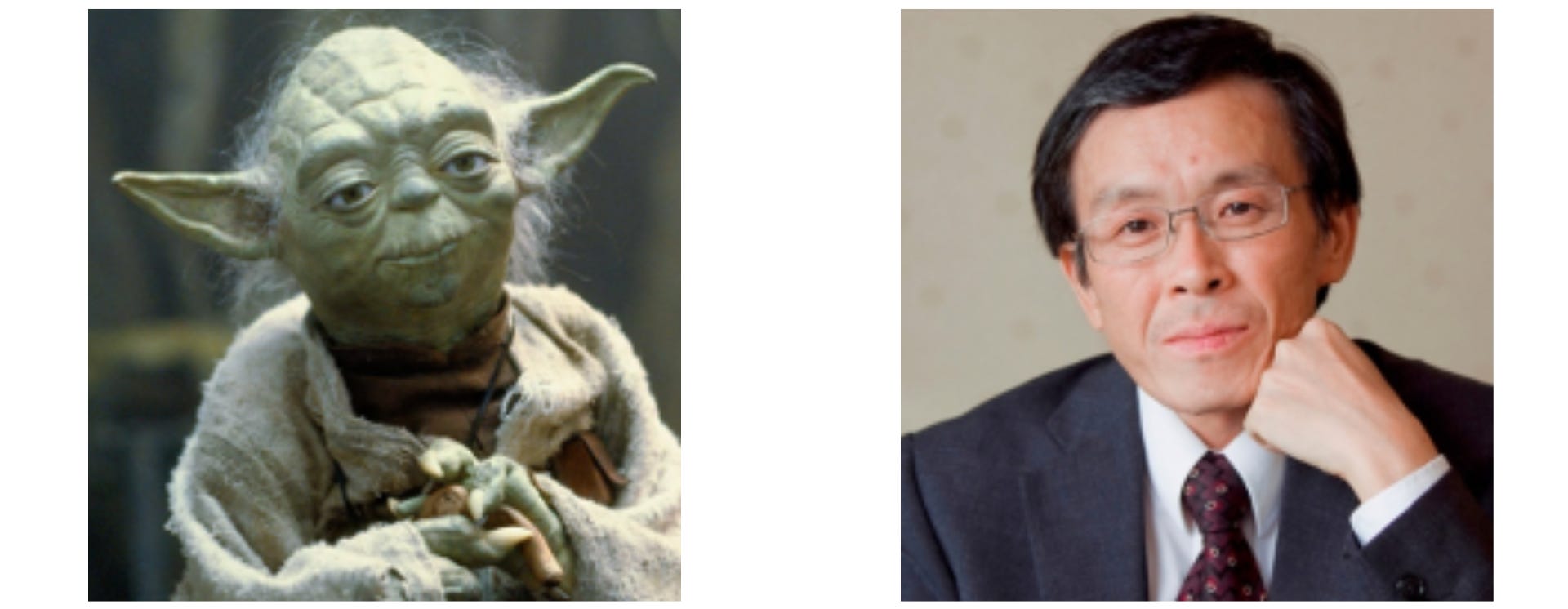
The book became a bestseller in Japan and Korea, then went through a TikTok viral transformation and emerged as an international monster bestseller. Crazy story. You never know what can catch on and what won’t. And if you look at the author… is it just me or does he look like a Japanese Yoda?
Core Ideas:
Your past doesn’t control you. You choose what meaning to give it, and you can choose differently right now.
All your problems are relationship problems. Every source of unhappiness leads back to other people.
Ask “whose task is this?” Your child’s grades, your boss’s mood, someone’s opinion of you — not your task. Most suffering comes from crossing that line.
Stop living for approval. If everyone likes you, you’re living everyone’s life but your own.
The courage to be disliked is the courage to be free.
Lindsay Gibson – Adult Children of Emotionally Immature Parents
A clinical psychologist with decades of experience, she’s almost the American mirror image of Kishimi, though she looks nothing like Yoda. More like your aunt whom you can talk anything to. Through working with her patients, she found a pattern of adults who had perfectly “fine” childhoods but couldn’t figure out why they felt so empty.
So she wrote about it in 2015. It started quiet. Then TikTok got ahold of it and young people started having what readers call “the light bulb moment”. Suddenly their entire childhood made sense. Bam! A million copies sold. Turns out a lot of people’s parents were emotionally immature.
By the way, why is it always TikTok that explodes things? Maybe March MINDness needs to be on TikTok too.
Core Ideas:
Emotional loneliness is the core wound. Your parents showed up physically but were absent emotionally. You grew up feeling invisible.
Four types of emotionally immature parents: the Emotional, the Driven, the Passive, and the Rejecting. Mix and match.
Role reversal is the hallmark. You didn’t have parents who raised you. You had parents you raised.
The healing fantasy keeps you stuck. No amount of trying will make your parent finally see you.
You aren’t betraying your parents by seeing them accurately.
The Comparison
Now let’s get back to your emotionally gassy friend. How would these two psychologists/philosophers/Yoda/aunt heal him? Well, from completely opposite directions.
Gibson would say “your parents’ immaturity is the cause of your present emptiness. An accurate diagnosis is the first step.” Kishimi would say “it doesn’t matter who caused what. Your future is now. Stop trying to use your past as an excuse.”
Gibson would say “it’s not your fault,” like Robin Williams said to Matt Damon in Good Will Hunting until Damon cried and hugged him. Kishimi would say “don’t ever let somebody tell you you can’t do something. Not even me. You got a dream, you got to protect it,” like Will Smith said to his son in The Pursuit of Happyness.
Gibson would end up cooking you some gumbo. Kishimi will take you to his favorite conveyor belt sushi, but you’ll probably have to pay for it.
Who’s right? Your vote! [up top]
My Vote
I got extremely lucky because my parents have always been there for me, so my personal experience dictates that I’m leaning Kishimi. But in a way, past-determining-present is exactly what Gibson is arguing. What a mind twister.
That said, I have always been a pretty here and now kind of guy. I’ve got my whole set of issues - ADHD, fear of rejection, task avoidance, and yes lactose intolerance. But as an avid fan of Cognitive Behavioral Therapy, I always try to turn my shortcomings into finding workarounds and building tools for myself and others. So I am almost allergic to looking at the past and cause, and always stare into the future.
My vote goes to Ichiro Kishimi.
But I don’t mind the gumbo and the hug though.
I like your series.
As always it's not black or white for me. I have a strong leaning towards Kishimi when it comes to living my life. Not taking myself too seriously has been a wonderful approach to pretty much everything, from my business to my parenting to martial arts.
What is important in Gibson's approach, is that many people who have not had the fortune of kind and emotionally available parents, internalize the feeling that there is something inherently wrong with them. Something that makes them unworthy of being loved and supported. Realizing that this is not the case, that rather it was the parents' incapacity of providing such an environment, can be very liberating to THEN move on to Kishimi. It's the simple difference between taking the blame for all my misery and taking responsibility for creating a better life.
If I'd be sitting in a plane, window seat, being cornered for 6 hours on a flight the thing i'd be worried least about is my anger. Rather I'd develop acute bowel urgency (lactose intolerance hits hard)