

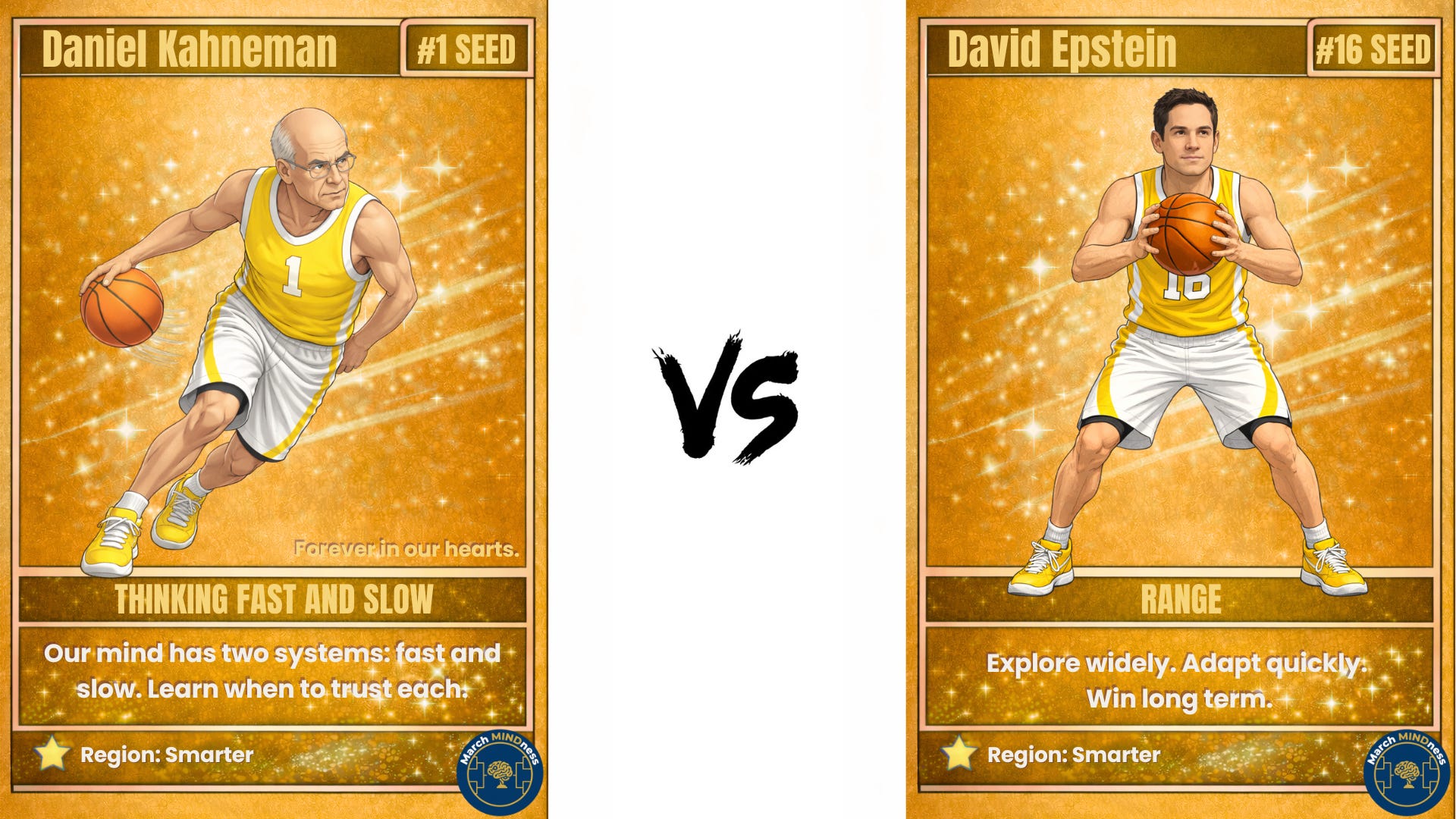
This is #1 vs #16 seed in the Smarter region of March MINDness. For those of you who aren’t familiar with a 64-entry bracket, this is usually the most lopsided match. The #1 seed is supposed to crush #16. In fact, in the NCAA basketball tournament history, a #16 seed has upset a #1 seed only 2 out of 160+ times.
It’s David vs Goliath. Or in this case, it’s literally David (Epstein) vs the Goliath of smart people.
By the way, due to the current news, I need to emphasize here, it’s David Epstein, the author of Range, not Jeffrey. I for one am so glad there isn’t a Jiang file somewhere. Otherwise I might have to put out a disclaimer every time I write something.
Daniel Kahneman – Thinking, Fast and Slow (2011)
He’s the #1 seed and I’m gonna go slow on this one.
A Lithuanian Jew growing up in WWII France, Kahneman was seven when the Nazis took over. One day, he was walking down the street with a Star of David on his sweater, a German SS soldier walked toward him. Kahneman thought he might die right there, but the soldier hugged him and showed him a photo of his own son and gave him money.
It was that moment that made Kahneman realize human beings are way more complicated than he originally thought. He spent the rest of his life pursuing one question as a psychologist staring down the field of economics — are people rational or not when making decisions?
That one question and thousands of studies laid the foundation of Behavioral Economics, and influenced so many popular authors like Richard Thaler (Nudge), Dan Ariely (Predictably Irrational), Robert Cialdini (Influence), Nassim Taleb (The Black Swan), The Heath Brothers (Made to Stick), Carol Dweck (Mindset) and Angela Duckworth (Grit), many of whom are in this bracket.
And for the book, it’s funny that it’s the best of 40 years of Kahneman’s research, and it was published AFTER so many of the popular authors listed above who took most of his ideas and wrote their own books already. Yet, Thinking, Fast and Slow still became a mega bestseller. It goes to show, if you’re good enough, no need to be first to market.
Summary:
Your brain has two systems. System 1 is the intuition that runs on fast autopilot. It’s the part that flinches at a loud noise, decides you don’t like someone within three seconds, and picks a fight with your spouse before you even know why you’re mad. System 2 is the slow one — the part you think of as “you,” the rational and logical engine.
Kahneman’s big argument is that the fast brain is actually in charge, and the slow brain is basically like the White House spokesperson or corporate PR whose job is to come up with justifications for decisions that were already made.
Other Core Ideas:
Loss aversion: Losing $100 feels twice as bad as finding $100 feels good. This is why you’ll stay in a bad job longer than you’ll chase a great one.
Anchoring: The first number you hear hijacks your brain. This is why whoever throws out a salary number first usually wins the negotiation.
WYSIATI: Your brain builds the best story from whatever’s in front of it and never asks “what am I missing?” You don’t feel ignorant. You feel confident. That’s the trap.
Planning fallacy: You estimate based on best case, not base rate. This is why every renovation goes over budget and every author misses their deadline.
Focusing illusion: Whatever you’re obsessing over right now feels like everything. Get the promotion, move to California, buy the car. Then you get there and you’re the same person with better weather.
David Epstein – Range
David (again, David) is a science journalist, investigative reporter, and former track athlete.
His career goes like this: NCAA athlete who held the 800-meter record. Arctic ecology researcher. Geology and astronomy in the Sonoran Desert. Worked on a seismic vessel that had been attacked by pirates. Senior writer at Sports Illustrated who helped break A-Rod’s steroid story. Investigative reporter at ProPublica. Podcast host at Slate. Sushi chef who built a restaurant chain. Massage therapist who won the Golden Moan Award.
No I made up the last two. But still, you wouldn’t have noticed. This guy is allergic to settling down and specializing in one field.
And guess what, he wrote a book about that topic. It’s so well written that Daniel Kahneman - the opponent David Epstein is up against in this matchup, reached out for lunch. Now that’s respect.
Summary:
The world keeps telling you to specialize early, pick your lane, and go deep. Epstein’s argument is: not so fast (or so deep). The people who end up the most successful and the most creative are the generalists who sampled widely, took detours, quit things that weren’t working, and connected ideas across fields that don’t normally talk to each other.
Other Core Ideas:
Kind vs wicked environments — Kind environments like chess and golf have clear rules and defined outcomes, so specializing early works. Almost everything else in real life doesn’t, so specializing late is better.
Match quality over grit — Quitting isn’t failure, it’s data. Switching paths isn’t lack of grit, it’s finding better fit.
Analogical thinking — The biggest breakthroughs come from importing solutions across unrelated fields. You can’t connect dots you’ve never visited.
Desirable difficulty — The training that feels the most frustrating sticks the deepest. If it went down easy, it probably didn’t last.
Comparison
The paths that produced these books are the complete opposite. Thinking, Fast and Slow is the culmination of 40 years of focused research from an academic. Range is the result of a journalist sampling different fields and connecting weird angles.
Thinking, Fast and Slow is a mile deep. Range is a mile wide. In a way, the contrast itself is the thesis of Range.
Kahneman’s framework is a defense system - here’s how your brain tricks you, here’s why you shouldn’t trust your instincts, here’s what to watch for. Epstein’s is an offense system - go try stuff, quit things, import ideas from weird places, stop optimizing and start exploring.
One teaches you to think correctly. The other teaches you to think widely. Kahneman wants you to slow down before you screw up. Epstein wants you to speed up before you miss out.
Daniel Kahneman won the Nobel Prize and set up an entire academic field. David Epstein… didn’t.
You decide.
My Vote
OK, everyone, please, please don’t do what I am about to do, and make your own judgment. Because I am about to let my System 1 take over and commit intellectual heresy.
I’M VOTING FOR DAVID EPSTEIN!
Before I get arrested by the Nobel committee, let me explain.
The idea of Range speaks to me deeply (or I should say widely). I started out my career wanting to be a computer programmer, then went into marketing, then built apps, then made my name in writing, vlogging, and speaking, then went back to building apps, and eventually built systems for undisciplined people like myself. Every piece of my career, failed or successful, contributed to who I am today. This weird self-help tournament is a product of connecting all kinds of hobbies — sports, self-help, hosting competition, writing. I am very much a believer and living example of Range.
Now, I also looooved Behavioral Economics. But I found it has a dark side - it makes me feel smart but hesitant. Ever since I got into this field, I started overanalyzing everything. I focused on optimizing my decisions, calculating my ROIs, and analyzing my fallacies. For a moment, I became a smart but safe guy.
But in the end, my heart wants to be the wild, hungry, and foolish guy. Trying and failing at everything, but then connecting all my failures into something successful and fun. That’s my life.
My vote goes to David Epstein.
But please, don’t vote like me. Or we will all get hit by lightning from smart heaven.
Oooh this was the hardest vote for me, but I picked Kahneman (even though I was lucky enough to be at David Epstein's book launch with Gladwell in NYC!). I love his concept of Systems 1 and 2 thinking
Guilty of googling ' Golden Moan award'