

If a 21-year-old comes to you for career and life advice, what would you say?
“Find your passion?”
“Try hard and try everything?”
“Don’t buy grocery store sushi?”
After a weekend of diarrhea, I’m going with the third one.
What about you?
If you ask around, you’ll see a million self-help authors giving you advice. And today, let me introduce two of the biggest ones, with millions of copies sold.
Just know, they’re not going to get along at a dinner table.
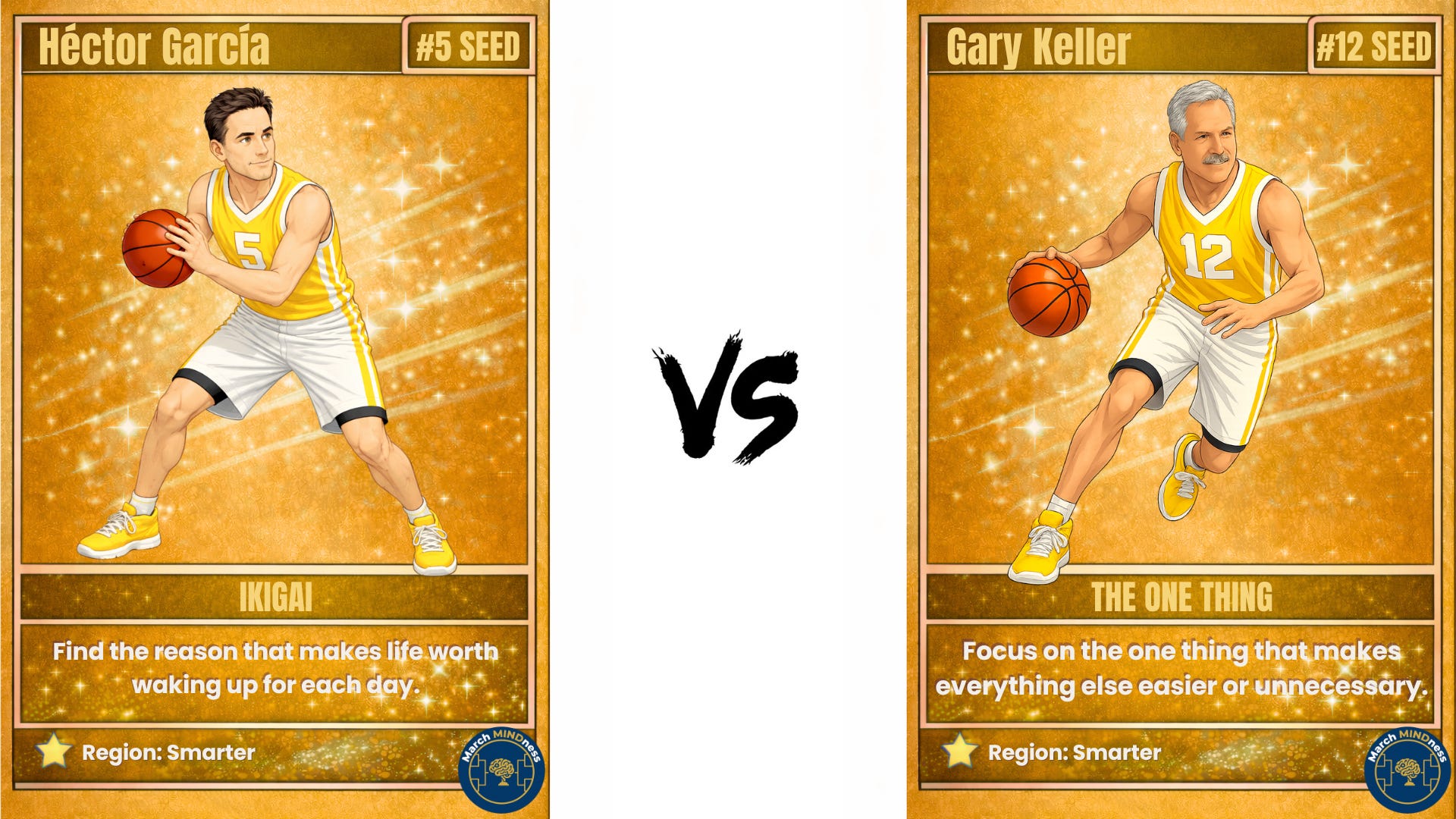
Héctor García
Born in Spain. Worked as a software engineer at CERN, the place where the World Wide Web was invented. Then he visited Japan and never left. Twenty-two years now. As a ramen addict, I don’t blame him at all. He went from software engineer to blogger to author to self-described “aspiring philosopher.” (Not a foodie. What a waste.)
His blog about Japanese culture became his first bestseller, A Geek in Japan. He then co-wrote Ikigai, which has been translated into 70 languages, making it the most translated book ever originally written in Spanish.
Interestingly, he’s the hardest to locate March MINDness author. There is a CPA named Hector Garcia with more YouTube views than him. Philosophers aren’t the online type.
The Book: Ikigai (2016)
The thesis: the people who live longest and happiest, like the centenarians in Okinawa, have found their ikigai, a Japanese word meaning “a reason to live” or “a reason to jump out of bed in the morning.”
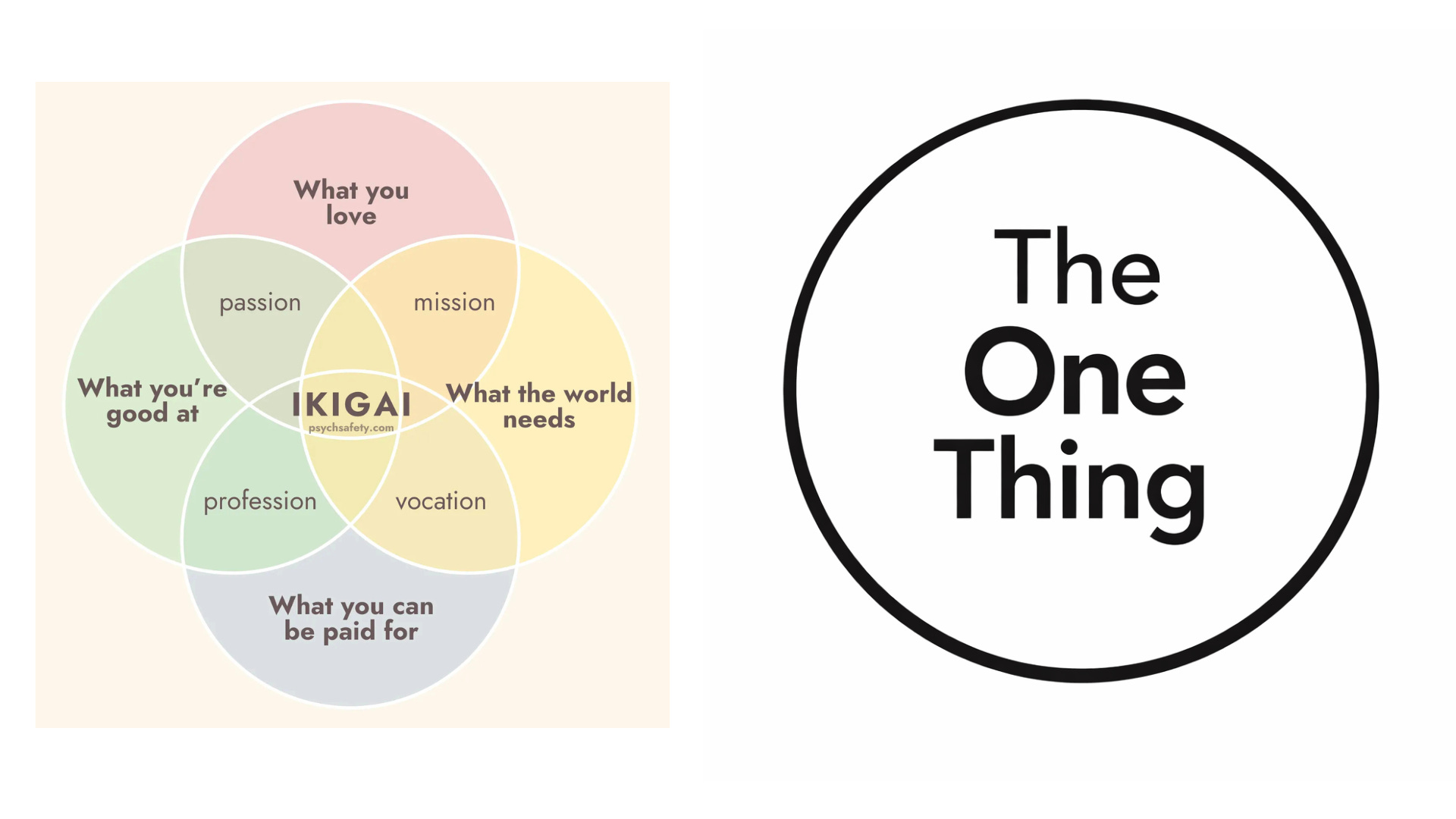
Ikigai sits at the intersection of four things: what you love, what you’re good at, what the world needs, and what you can be paid for. That’s your reason for being. The Japanese don’t really have a concept of retirement. They keep working at what they enjoy because they’ve found ikigai, the happiness of always being busy.
Core Ideas:
Everyone has an ikigai. Your reason for existing. You just have to find it, big or small.
Stay active, don’t retire. The centenarians in Okinawa never stopped working. Staying engaged and purposeful is what keeps you alive.
Slow down and focus. Don’t multitask. The Japanese approach of giving full attention to one task produces better work and more satisfaction. Flow state over hustle.
Community sustains you. Strong social bonds, the moai (social groups) of Okinawa, are as important as diet and exercise. Loneliness kills. Connection heals.
Follow your curiosity. García himself embodies this. CERN to Japan to photography to philosophy to writing. The journey to finding your ikigai is itself part of the ikigai.
Gary Keller
Born in Texas, both parents were schoolteachers. Originally wanted to be a professional musician but fell in love with real estate. In 1983, he co-founded Keller Williams Realty from a single office in Austin. Built it into the largest real estate company in the world by agent count, over 180,000 agents worldwide.
He now has his own band and owns two music venues. The guy wanted to be a musician, became a real estate mogul, and found a way to be both.
If you watch his interviews and talks, he looks like Colonel Sanders dressed like Steve Jobs.
The Book: The ONE Thing (2013)
The thesis is aggressively simple: extraordinary results come from narrowing your focus to one thing. Not five priorities. Not three. One.
The book builds on Pareto’s principle (20% of effort produces 80% of results) but takes it further. Keller says keep narrowing. Find the 20% of the 20%. Find the one domino that knocks over everything else. Then give it four hours of your day, every day.
Core Ideas:
The Focusing Question. “What’s the ONE thing I can do such that by doing it everything else will be easier or unnecessary?” Apply it to your career, health, relationships, finances, everything.
Multitasking is a lie. You’re not doing two things at once. You’re doing two things poorly in rapid succession. Focus on one thing at a time.
Not everything matters equally. Most to-do lists are survival lists, not success lists. Find the thing that actually moves the needle and ignore the rest.
Willpower is finite. It’s not always available on demand. Do your most important work early in the day when willpower is highest. Don’t waste it on decisions that don’t matter.
“Work is a rubber ball.” It bounces back if you drop it. Family, health, friends, and integrity are glass balls. Drop one and it shatters. So protect those and be ruthless about your work focus.
Comparison
García looks at your life and sees an intersection with four circles. If any circle is empty, you’re out of balance. The goal is harmony. Find where all four overlap and plant yourself there.
Keller looks at your life and sees a to-do list with 47 items on it. He wants to cross out 46. The goal isn’t balance, it’s clarity. Find the one thing that matters most right now, and give it everything. Everything else is a distraction disguised as responsibility.
García would tell that 21-year-old: explore. Travel. Try things. Follow your curiosity across disciplines and cultures. Your ikigai will reveal itself at the intersection of your passions, skills, needs, and income. There’s no rush.
Keller would tell that same kid: stop exploring and start focusing. Ask yourself one question every morning. “What’s the ONE thing I can do today such that everything else becomes easier or unnecessary?” Give it four hours before you check your phone. The people who “explore” for a decade end up 31 with a great Instagram and no direction or momentum.
García would point you to Okinawa, the island with the most centenarians, to see people with purpose, harmony, and balance.
Keller would show you 180,000 agents building real estate empires as examples of intensity and accomplishment.
García would recommend the best sushi and sake in Tokyo.
Keller would take you to Salt Lick BBQ in Austin.
(If you ever need a food recommendation in either Tokyo or Austin, hit me up.)
Their contrast is one of the oldest debates in philosophy. Eastern vs Western, fulfillment vs achievement, harmonic balance vs intense singularity.
Who do you vote for?
My Vote
I enjoy the core ideas of both of these books, and I share García’s affinity for Japan. In fact, to write my own book, I went to Japan specifically for philosophical dust. Staring at Mt. Fuji and walking around Lake Kawaguchi gave me the inspiration to title my book Easy Discipline. I even wrote a chapter based on another Japanese concept, Ichigo Ichie.
That said, I’m putting my foot down and voting against Ikigai. For two reasons:
1. The four circles thing is a personal version of the Hedgehog Concept Jim Collins made famous in Good to Great, which advises companies to find what sits at the intersection of what you’re deeply passionate about, what you can be the best in the world at, and what drives your economic engine. That’s the same as “what you love, what you’re good at, what you can be paid for.” It doesn’t feel very original.
2. If you ask a Japanese person, they know what ikigai is, but they wouldn’t know what the famous Venn diagram is all about. It feels like putting a pie chart on Plato’s Republic, or a 2x2 matrix for Buddha’s teaching. I’m not a fan of McKinseyfying philosophies.
For that reason, I am voting for The ONE Thing.
I try to vote before I read what you think- which I did this time, but after reading your thoughts I wanted to change my vote!
Ikigai definitely appeals to me, and has been a principle I've been aware of for longer (and want to explore). However, there is definitely a factual, painful truthfulness in the pareto principle. Its so simple that its hard. Succes can be so easy, but we make it hard, because we dont believe it can be easy. It sounds a lot nicer saying you had 5 ups and downs before finding your passion (the plot thickens). Yet, finding that one thing that matters by analysing the things you already do is probably the single most exponential move you can make.
The choice therefore is (and most choose a mix of both, few hardliners I'd argue, except maybe David Goggins)
Ikigai - Choose your own path by walking a bit on every path
Pareto - look back at your GPS at the most meaningful path, set course and then throw away the map