

This will be the 183rd article about AI you will come across today. It will not be the popular topics: productivity hacks and tool list, industry news and trend, or business strategies.
My newsletter is about the real lessons – insights you don’t find in the flashy headlines and noisy conversations.
Today I am writing about you finding greatness in the world where everyone is good.
There is a scene in the Big Bang Theory (I know you are too sophisticated to like the show, but I watched and loved it, along with 150M Americans. Dismiss us at your own peril. We might take your political party, win the next election, and put Sheldon with Flags on NPR), Penny was interested in acting again after a successful stint in pharmaceutical sales, entered into an audition and found 20 other beautiful blonds just like her, and quickly remembered why she hated and left the profession in the first place.
Here is the unfortunate truth, we are all gonna be like Penny going forward.
The world used to be divided with this faultline – those who suck at their job and those who don’t. Through education, hard work and experiences, you cross the “don’t suck” faultline and make a good living.
But AI changed everything. Everyone’s got in their pocket a super intelligence who knows everything about anything. No one sucks at their job anymore.
We have entered the Age of Competence.
And in this age, we have a new faultline drawn – those who are competent and those who are great.
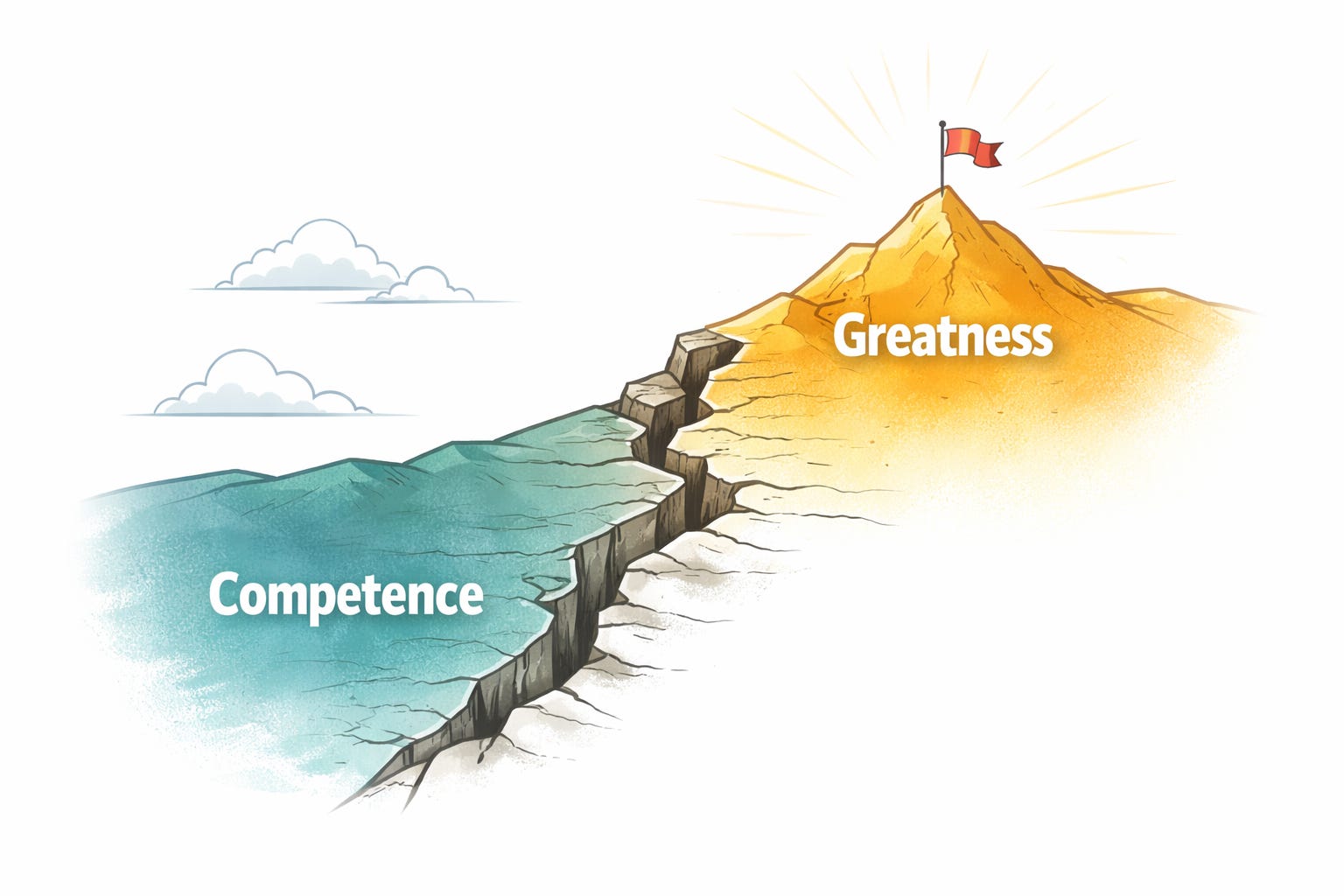
If you are in the competent camp, you will feel like Penny, competing against people who are as knowledgeable, as fast and as hardworking as you. And you will be in constant danger of being replaced.
That’s why you need to cross the greatness faultline. And this is what the article is about.
Three lessons to become GREAT in AI fueled Age of Competence.
1. Get wild
When everyone sounds like AI, you can stand out by sounding like you – the wild version. So get wild.
I once faced a similar situation. In my 20s, I was a college graduate with a Computer Science degree, who both sucked at and hated programming. I was fired from one job after another. Life was grinding fest plus despair buffet plus regret gala. To make a change, I was thinking about getting a MBA. I had so little confidence left I went to the US News Best MBA list and searched from bottom up.
My hero lawyer uncle (I wrote about him in my article on Four Ideas to Make America Great Again) told me “no. Search top down! If you are gonna spend two years of your time while getting a $120K tuition loan, go to the best school.”
“Winners go home and fuck the prom queen,” said my uncle. (Actually that’s from Sean Connery, although I really wish my uncle would say that to me.)
So what could a career failure who was both despised and incompetent at his job write on his application essay to convince a top business school he’s not a delusional joke?
There was only one option – get wild.
And I did. Instead of writing an airtight essay just like everyone else, like the ones written by AI now, bragging about career accomplishments, citing a “time I dealt with a challenging situation,” and convincing why the school and I were a match in heaven, I did the opposite.
I went wild, treating my essay like a proclamation to the world, about my dreams, ideas, flaws, faith and determinations. I boldly painted a more colorful, kind and brave world with me being part of it. I wrote like a poet, a dreamer, a delusional artist, like I wasn’t applying for school but auditioning for a Dead Poets Society.
Was I that person? Not yet.
Did I believe I could become that person? Absolutely!
Was being my authentic, wild self? 100%!
It was a crazy move, like Chris Gardner (Will Smith) in the Pursuit of Happyness, turning a situation of despair (showing up to his dream job interview late and in garbage dress into an ice-breaker).
And it worked. Four schools turned me down, and one took me in. The one that took me in was my dream school all along – Duke.
Those two years at Duke were two of the best – got a world-class education, met my best friends, married my soulmate.
OK enough of me and my story. Let’s talk about you.
Like it or not, you are in that situation now. In the Age of Competence, everyone has good solutions and answers. Everyone can write articles with wacky emojis. Everyone can write emails like Program Managers at Google. If you think you can solely rely on AI and be adequate with your job, you will just be like everyone else. There is no way to differentiate. There is no way to impact.
Eventually, the people who rely on AI will indeed be replaced by AI.
You AI, you die.
OK above was for rhyming, but not accuracy. Let me try a new line.
If you AI only, you die lonely.
There... Maybe.
The Age of Competence also gives you the permission to be your wild, authentic self.
No, not permission. Requirement.
Here is the truth. What AI does well
Correct
Collectively acceptable
Good
What AI doesn’t do well:
Wild
Authentically you
Greatness
So who does wild, authentic and greatness well? You! The real you, the true you, the one who’s hidden beneath layers of wanting to be correct; the one who’s shackled by needing to be liked by others; the one who’s beaten down by never-ending imposter syndrome.
Now when everyone has the same AI-plastic look, you can’t hide the real you anymore. You’ve got to let out and unleash that person into the world.
Work and live like you are making your own proclamation every day. Write and love like you are painting a masterpiece on this world of canvas.
That’s how you become great.
2. [Dictator Corner] How to AI without trusting AI
This advice is only for dictators and most billionaires. If you are not one of those, skip to #3.
Hi Mr. Ali Khamenei, the Supreme Leader of Iran, I am writing this section to advise you, so you can be a great dictator in the age of competent dictators.
Your country is in total chaos. I know exactly what you are itching for, like the rest of us when in a state of terror and confusion – using AI.
I know every minute, you are tempted to type this into ChatGPT: “I’m the mighty Supreme Leader of Iran. My people are protesting on the street. Trump already bombed my nuclear silo, and is now threatening to bomb on my palace. How do I get out of this bind?”
But of course. You can’t. You know Sam Altman is watching your inputs like a stalker with a peephole. You know everything you type in is intelligence gold for the CIA and Mossad. The same goes for Gemini or Grok.
In fact, Sundar Pichai, Elon Musk and Sam Altman are probably having a $80M side bet on whose AI you will beg first.
Deepseek and all the Chinese AIs? No. You don’t trust Xi Jinping either.
So you are stuck. You are in a worse situation than all of us, because everyone else can AI, but you can’t.

So I’m gonna help you this time. All I ask in return is you make every Iranian buy my new book when it comes out. It helps with Amazon ranking if it can dominate the Middle East.
I’ll do the AI query for you and tell you the result:
ChatGPT and Gemini are pretty useless. They both said “get lost! I know who you are and all your dark secrets. You are Jia Jiang, not Khamenei. Even if you were Khamenei, I can’t answer this without risking a PR disaster of someone posting my response on X and accusing me of helping you.” ChatGPT sounds even angry. Coward!
Deepseek is the most matter of fact. It gave you three pathways 1. Crush the protest quicker and faster 2. Offer concession to address protesters’ grievances and deescalate 3. Blame everything on the West and rally a counter nationalist movement.
Grok is the worst. It called me “bad boy” and started flirting in Persian. I translated it. It got dirty quick.
But I can’t do every search for you going forward, so I’ll give you some long-term solutions.
Get all the young and bright minds in Iran in a room and build your own AI. Do it quick before they join the protest themselves. Call it Persimini or FarsiGPT.
If you can’t build the AI fast enough, build human AI. Call it AAI (Artificial Artificial Intelligence). Put your smartest people in separate rooms. Any time you have a query, send to all of them for ideas. Then get someone to pick and present you the three best ones. I bet the result are as good as AI. In fact, I’d love to have an AI-off, a competition between 100 smartest Iranians and ChatGPT, and see who will win.
If all the young, smart people are already protesting on the street, you can try this. Get 100 dumb (or regularly intelligent) people, and put them in rooms. Any time you have a question, ask those 100 people to query ChatGPT simultaneously, with one real query and 99 fakes ones.
So if your real question is “how to end a protest”, you mix in with
“How to say ‘screw off’ in Hebrew?”
“When Trump said the most beautiful chocolate cake, what does it look like?”
“Is Sarah Shahi single?”
“What’s the best adult diapers for an 86-year-old on Amazon?”
The CIA and Mossad will be so confused and don’t know which one is real, only you do! You win! Problem solved.
In the show Silicon Valley, billionaire Gavin Belson had blood boys to keep himself young with blood infusions. In 2026, your AAI squad are the new blood boys.
3. Protect your “why”
OK, back to lessons for normal people.
Yesterday, at the end of one of my speeches, a worried dad raised his hand and asked me this:
“My daughter is entering college and really wants to major in art and animations. I told her that’s not gonna work. It’s gonna be replaced by AI if not already. How do I tell her?”
This question has haunted me the past couple of days.
I do understand his worry. I really do.
What major ISN’T going to be replaced by AI? No one knows the answer. I certainly don’t. Coding was failproof five years ago, now it’s in danger of mass unemployment. The same goes for lawyers, writers, etc.
But I do know what won’t be replaced by AI: passion, love and obsession. They are the “why” of doing things.
Too many people worry about the “how”. They look and predict the future and try to get on the right boat.
But they forget about the “why”.
The “why” is what will drive people through the darkest times and reach unprecedented heights.
The “why” is how people dedicate years and decades making groundbreaking art.
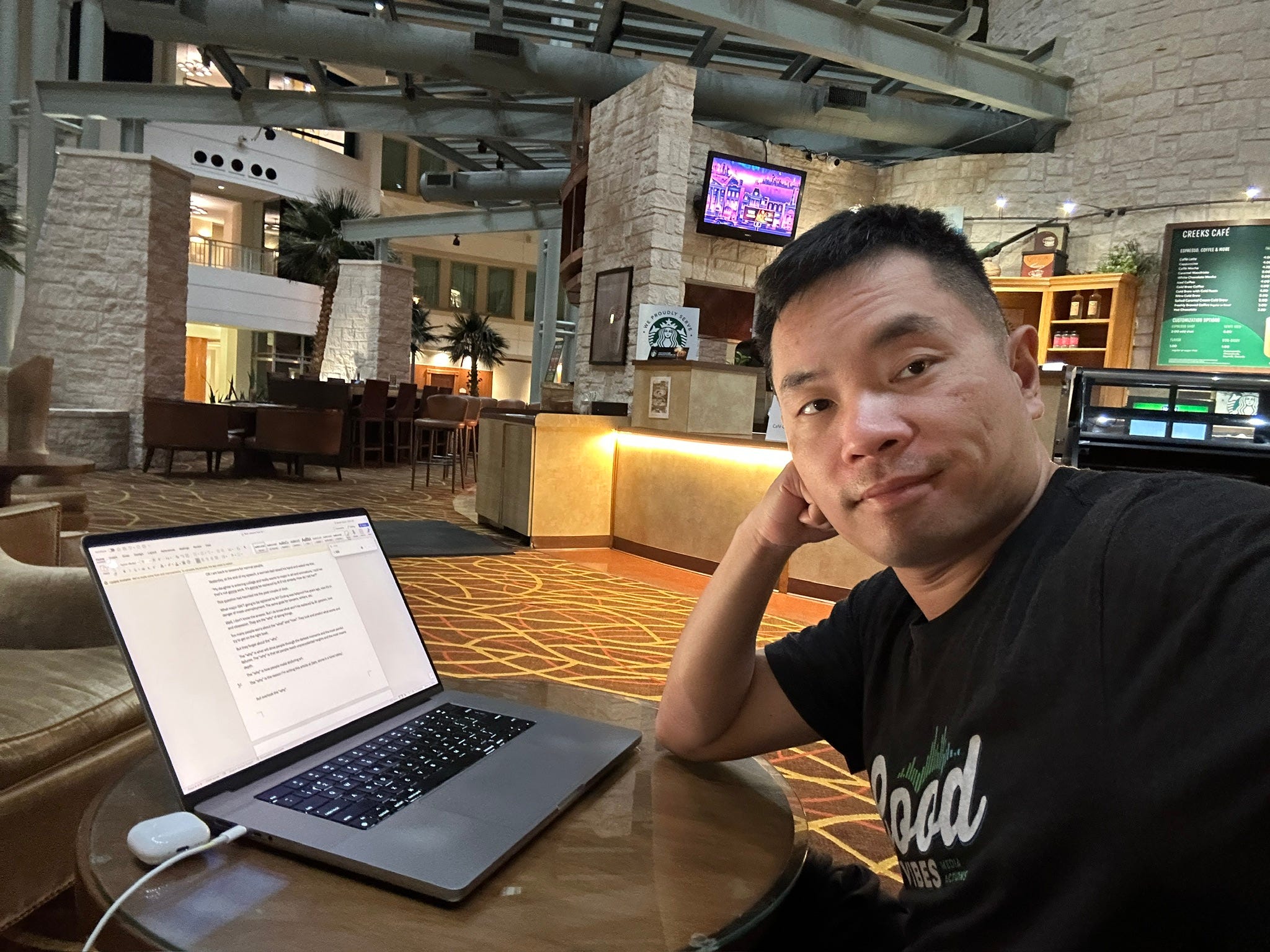
The “why” is the reason this 44-year-old is writing this newsletter at 2:24am, alone in a hotel lobby.
If you get your “why” right, the “how” will follow. Tools like AI will be there to serve your “how”.
You probably know I love The Pursuit of Happyness. I already quoted it early in the article. But my favorite scene? It was Chris Gardner’s speech to his son who loves basketball.
“Don’t ever let someone tell you, you can’t do something. Not even me. You got a dream, you got to protect it.”
Chris Gardner’s son has his “why”. The daughter of the worried dad who asked me that question has her “why”. AI can’t take it away, and neither should the dad.
What’s your “why?”
No matter what it is, protect it like your life depends on it.
Because in the world of AI, in the Age of Competence, your life might literally depend on it.
Be great, y’all!
Recently my old job from a company I helped built asked me to come back to work for them after I left because I grew disgusted with how they operated and you know what I did?
I applied to be a DJ for a radio podcast I heard streaming from a video game, did a radio demo, etc (I didn't get it, fyi), but that's besides the point. Now I'm waiting to apply for another startup that I may also get rejected from. Just trying a new thing, seeing a problem from a new angle made me feel so uncomfortable and so much better.
My point is that I agree with you: get wild, protect your why, all of it. As a neurodivergent self-advocate, I get that question from parents like the art student's all the time. She's essentially being unreasonable.
My slightly modified quote from Shaw sums it up well: "The reasonable person adapts themself to AI; the unreasonable person persists in trying to adapt AI to themself. Therefore all progress depends on the unreasonable person."
If humanity has to come to the point that the only way to protect that art student's why is to implement a Basic Income for the Arts like Ireland, then so be it.
I'm rereading The Freak Factor, Pink Goldfish, and Rejection Proof for that exact reason. I won't let the sadistic AI overlords take my why without a goddamn fight. They'll have to pry it from my cold dead fingers. I'll get mean, I'll get angry, I'll get crazy, and I won't give up. More people gotta get like that or frankly humanity won't survive.
I don't want violence to get this. But no matter what the future holds, I believe AI WILL make people wild, desperate, struggle, and freak out. Personally, I think that's a FANTASTIC thing. It'll show us who we are in extremis.
Wowza, 183 articles, that is epic. Go Wild! Love all your writing style and articles. This one especially landed for me. The framing of an Age of Competence captures exactly what many people are feeling but have not yet articulated. When everyone can be good, being good is no longer the differentiator. Voice, judgment, courage, and a protected why are. Resonating the call to get wild in a thoughtful way and to stop outsourcing identity to tools. Be yourself folks, the truest and realest you - and use AI to do the boring routine stuff so you can shine in your "you-ness" even more. This is a sharp, honest piece that cuts through the AI noise by focusing on what still makes us human and what still makes us matter.